Experimental Engineering course (E80), Harvey Mudd College · Spring 2026 · Team of 4
Basilisk: Autonomous Surface Vehicle for Wind & Solar Surveys
Offshore wind and floating solar farms need local data on wind speed, wind direction, and sunlight. For Harvey Mudd’s Experimental Engineering course, our team of four built Basilisk, an autonomous surface vehicle (ASV) that logs all three while underway. We tested it in a pool, then a lake, then deployed it in the ocean at Dana Point, CA, to see whether energy potential changes with distance from shore. I designed, built, and calibrated its two wind sensors.
Role: wind sensor design & calibration · Team management · Tools: Teensy 4.0, Arduino, oscilloscope, wind tunnel · Tested: tank → pool → lake → ocean
My contribution: the wind sensors
I designed the circuits for both wind sensors and built and calibrated them, with Andy Maldonado Martinez co-building the housings. Both feed a Teensy 4.0 that logs to a microSD card.
Anemometer (wind speed)
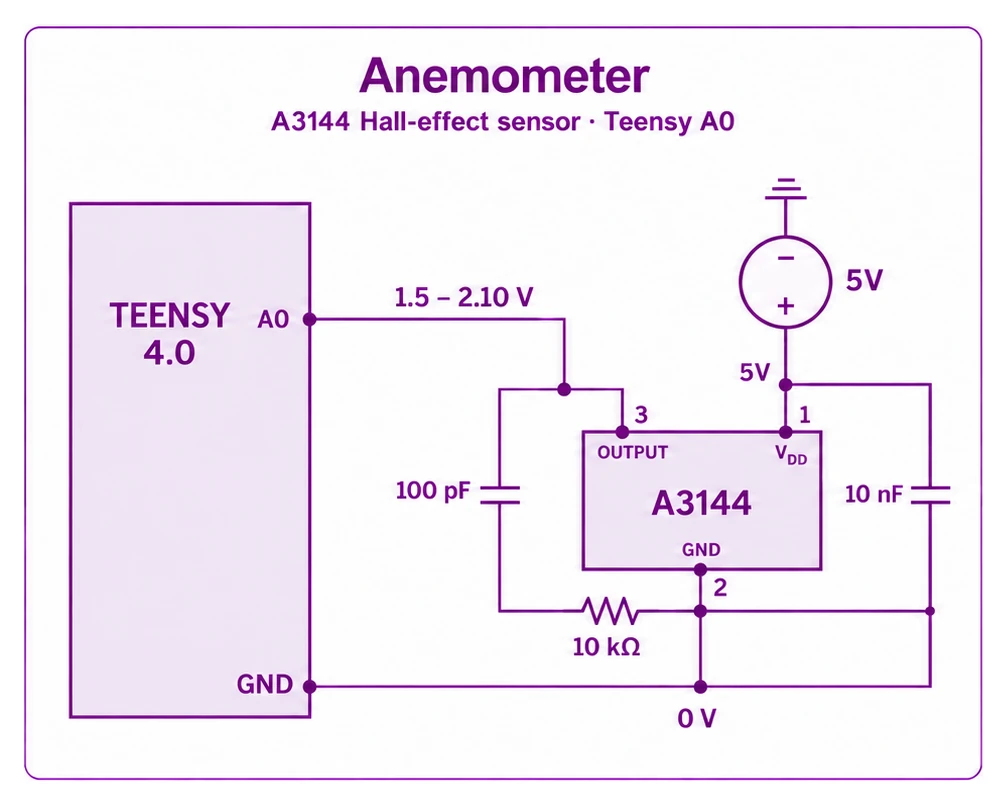
A magnet on the spinning cup shaft passes an A3144 Hall-effect switch once per rotation. The switch pulls the line low, a 10 kΩ pull-up brings it back high, and the Teensy counts pulses over a fixed window to get the rotation rate. I tested it repeatedly in Harvey Mudd’s wind tunnel at increasing fan speeds, first watching the pulses on an oscilloscope and then counting them in Arduino code. The result was a linear speed calibration with R² = 0.99.
Wind vane (direction)
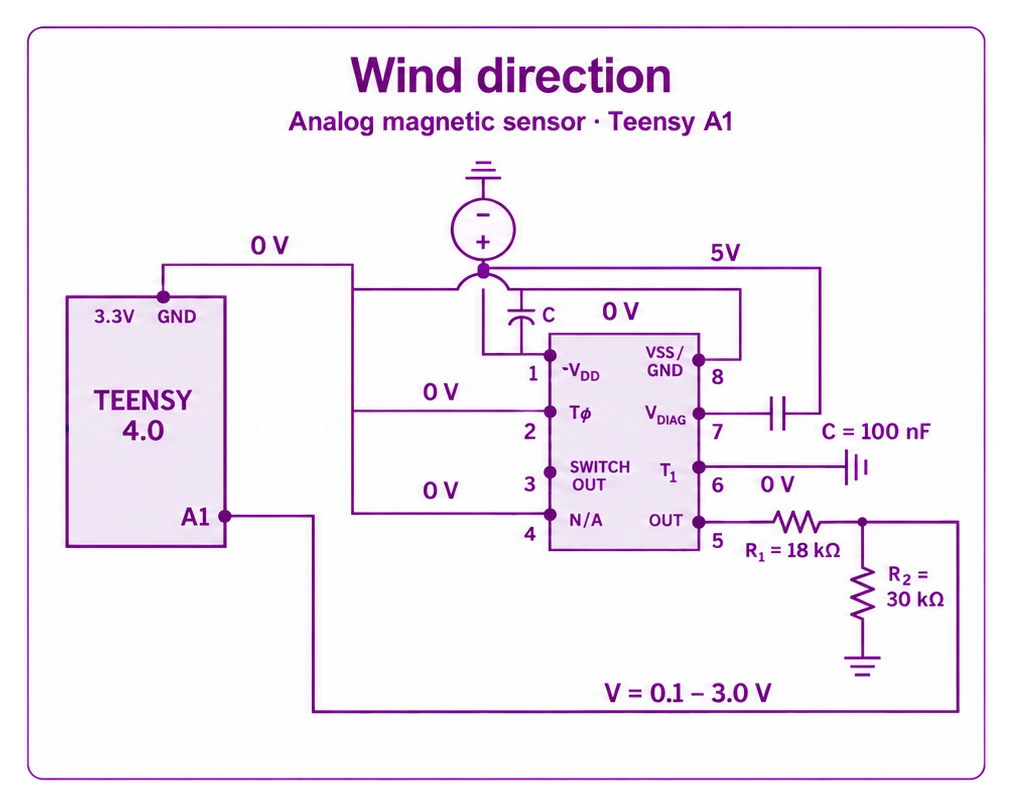
An MLX90316 rotary position sensor reads the angle of stacked magnets that turn with the vane, without touching them. Its analog output passes through a voltage divider (18 kΩ / 30 kΩ) to stay within the Teensy’s input range. To calibrate it, I swept the vane through a full circle and recorded the minimum and maximum voltages (0.094 V and 3.000 V). I then mapped that range to angle, zeroed it to the ASV’s forward direction, and combined it with the IMU heading to get true wind direction.

Mounting and waterproofing
The sensor mounts had to balance two needs: sealed enough to survive waves and rain, but easy to take apart for troubleshooting. We fed every wire through penetrator bolts into a small sealed electronics enclosure. That trade-off paid off on launch day: we found the vane’s magnets were oriented with the wrong polarity, so the sensor was reading nothing, and we disassembled and fixed it in the field.

What we observed
These are results from one morning at one site, not general conclusions about offshore energy. Across three runs at Dana Point, reaching about 60 m from shore, neither wind nor sunlight changed significantly with distance. The cove’s breakwater sheltered it: average wind was 2.16 m/s, mostly from the southeast, and solar power density was about 72× the wind power density.
What I’d change
The anemometer stopped keeping up above about 5 m/s in the wind tunnel, because the magnet strength and sensor sensitivity limited the pulse count. That made the calibration valid only at low speeds. A stronger magnet or a more sensitive Hall sensor would extend the range, and closed-loop steering would keep the ASV on its heading.
Team: Samara Baidwan (team management, wind sensors), Ava Barasch (mechanical and protoboard design), Andy Maldonado Martinez (3D assembly and calibration), Felix Peng (digital interfacing, photodiode subsystem, MATLAB processing)
Next project